Standard Handbook of Electronic Engineering, Fifth Edition
Jay A. Alexander
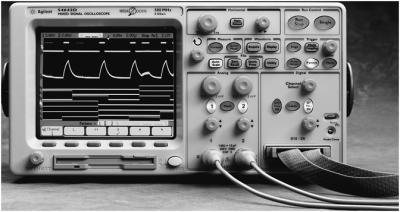
The word oscilloscope has evolved to describe any of a variety of electronic instruments used to observe, measure, and record transient physical phenomena and present the results in graphic form (Fig. 25.5.1). Perhaps the popularity and usefulness of the oscilloscope spring from its exploitation of the relationship between vision and understanding. In any event, several generations of technical workers have found it to be an important tool in a wide variety of settings.
The prototypical oscilloscope produces a two-dimensional graph with the voltage applied at the input plotted on the vertical axis and time plotted on the horizontal axis (Fig. 25.5.2). Usually the image appears as an illuminated trace on the screen of a cathode-ray tube (CRT) or liquid-crystal display (LCD) and is used to construct a model or representation of how the instantaneous magnitude of some quantity varies during a particular time interval. The quantity measured is often a changing voltage in an electronic circuit. However, it could be something else, such as electric current, acceleration, or light intensity, which has been changed into a voltage by a suitable transducer. The time interval over which the phenomenon is viewed may vary over many orders of magnitude, allowing measurements of events that proceed too quickly...