Standard Handbook of Electronic Engineering, Fifth Edition
Rex Chappell
For measurements of frequency, time interval, phase, event counting, and many other related signal parameters, the ideal instrument to use is an electronic counter or its cousin, the frequency and time-interval analyzer. These instruments offer high precision and analysis for research and development applications, high throughput for manufacturing applications, and low cost and portability for service applications.
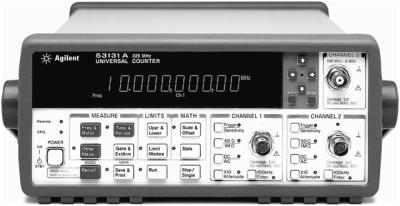
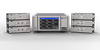
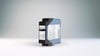
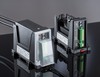
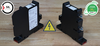
Electronic counters come in a variety of forms (Fig. 25.1.1).
[*]Adapted from Chapter 19, Electronic Instrument Handbook, 3rd ed., Clyde Coombs Jr. (ed.), McGraw-Hill, 1999. counter. When two-channel functions, such as time interval, are provided, the instrument is usually called a universal counter. This name reflects this instrument s wide variety of applications. Several measurement functions provided by universal counters are shown in Fig. 25.1.2.
The earliest electronic counters were used to count such things as atomic events. Before counters were invented, frequency measurement was accomplished with a frequency meter, a tuned device with low accuracy. Frequency counters were among the first instruments to digitally measure a signal parameter, yielding a more precise measurement. Today, they are still among the most precise instruments. Characterizing transmitters and receivers is the most common application for a frequency counter. The transmitter s frequency must be verified and calibrated to comply with government...