Chapter List
- Chapter 15: Elementary Kinetic Theory
- Chapter 16: Kinetics of Molecular Transport
- Chapter 17: Chemical Kinetics
We have previously shown that the translational energy mode for an ideal gas, even through a shock wave, invariably displays classical equilibrium behavior. In contrast, the rotational, vibrational, and electronic modes generally require significant time for re-equilibration upon disturbances in their equilibrium particle distributions. On this basis, we may expand our statistical discourse to nonequilibrium topics by grounding any dynamic redistribution on the presumption of translational equilibrium. For this reason, we now shift to elementary kinetic theory, which focuses solely on the translational motion of a gaseous assembly. Specifically, in this chapter, we consider equilibrium kinetic theory and its applications to velocity distributions, surface collisions, and pressure calculations. We then proceed to nonequilibrium kinetic theory with particular emphasis on calculations of transport properties and chemical reaction rates, as pursued in Chapters 16 and 17, respectively.
15.1 The Maxwell Boltzmann Velocity Distribution
In Section 9.1, we showed that the translational energy mode for a dilute assembly displays classical behavior because of the inherently minute spacing between its discrete energy levels ( ? ? ? kT) . Under such conditions, the partition function can be expressed in terms of the phase integral, ?, thus giving, from Eqs. (8.22) and (8.23),
| (15.1) | 
|
Therefore, for a single particle circumscribed by three Cartesian coordinates, the translational partition function becomes, from Eq. (15.1),
| (15.2) | 
|
where
| (15.3) | 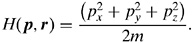
|
Now, from our statistical development in Section 4.3, the...
Copyright Cambridge University Press 2005 under license agreement with Books24x7

 TABLE OF CONTENTS