D.1 Method of Lagrange Multipliers
Consider a continuous function, f( x, y, z) , which depends on the three independent variables, x, y, and z. To determine the maximum or minimum of this function, we normally invoke
| (D.1) | 
|
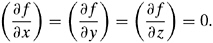
which simply requires
Now, suppose that x, y, and z are not independent variables but are instead related through two independent and continuous constraints,
| (D.2) | 
|
| (D.3) | 
|
Since g 1 and g 2 are each constant, the differential of each must be zero so that
| (D.4) | 
|
| (D.5) | 
|
Multiplying Eqs. (D.4) and (D.5) by the constants ? 1 and ? 2 , respectively, and adding the results to Eq. (D.1) yields the combined requirement,
| (D.6) | 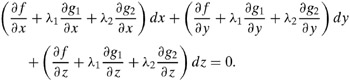
|
Given the two applied constraints, two of the three variables, say x and y, must depend on the remaining variable, z. Consequently, the first two terms of Eq. (D.6) can be zero only by choosing ? 1 and ? 2 so that
| (D.7) | 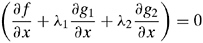
|
| (D.8) | 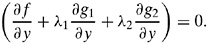
|
Having selected ? 1 and ? 2 , the only way that Eq. (D.6) can be zero for any arbitrary value of dz is for its coefficient to be identically zero, or
| (D.9) | 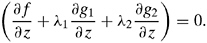
|
Analogous arguments hold for any arbitrary choice of the independent variable. Hence, in general, the extremum is defined in all cases by the same three expressions, namely, Eqs. (D.7), (D.8), and (D.9). Including the two constraints, Eqs. (D.2) and...

 TABLE OF CONTENTS