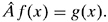
An operator is a mathematical rule, or set or rules, which transforms one function into another without necessarily specifying any particular function. Mathematically, we define the general operator, , as
Examples of might be (1) multiply by x or (2) take the first derivative with respect to x. In the first case, is simply x and g( x) = xf( x) . In the second case, is d/ dx and g( x) = df( x)/ dx.
Some of the basic rules of operator algebra are as follows:
| (H.1) | 
|
| (H.2) | 
|
| (H.3) | 
|
| (H.4) | 
|
| (H.5) | 
|
where C is a constant. The identity operator, , is the operator which leaves the function unchanged; the null operator, , is the operator which yields zero when operating on any function:
| (H.6) | 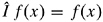
|
| (H.7) | 
|
Note that, in Eqs. (H.4) and (H.5), we dropped any explicit reference to the function f( x) . This is the usual way of writing the equations of operator algebra.
Most operators encountered in the physical sciences are linear operators. An operator, , is linear if
| (H.8) | 
|
An example of a nonlinear operator is the square-root execution. In general, the results from two operations do not commute, so that  = . Hence, if we define the commutator, [ , ], as
| (H.9) | 
|
the operators and can...
Copyright Cambridge University Press 2005 under license agreement with Books24x7

 TABLE OF CONTENTS