Having applied statistical mechanics to nonreactive and reactive gaseous mixtures, we now shift from our study of the dilute limit to fundamental statistical interpretations of undoubtedly the three most salient concepts in classical thermodynamics, namely, work, heat, and entropy. We first introduce a unified microscopic viewpoint for reversible work and heat, followed by an exploration of the statistical foundations underlying the second law of thermodynamics. We then develop a more robust statistical definition of the entropy, which leads directly to a novel interpretation of this pivotal property in terms of statistical information. We complete this chapter by showing how such information can provide a more general stochastic formulation for physical phenomena, with statistical thermodynamics being a particularly cogent example of the power of information theory.
12.1 Reversible Work and Heat
We recall from classical thermodynamics that, for a simple closed system, reversible work can be evaluated via
| (12.1) | 
|
while reversible heat can be expressed as
| (12.2) | 
|
On this basis, the first law of thermodynamics becomes (Appendix F)
| (12.3) | 
|
In comparison, from Eq. (4.19), statistical thermodynamics gives
| (12.4) | 
|
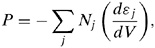
However, from Eq. (3.30), we may write, for any system of independent particles,
for which ? j is solely a function of volume. Consequently, from Eq. (12.1), reversible work can be expressed as
| (12.5) | 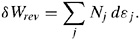
|
Comparing Eqs. (12.3) and (12.4), we then have, for reversible heat,
| (12.6) | 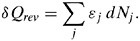
|
Despite their apparent simplicity, Eqs. (12.5) and...


 TABLE OF CONTENTS