Classical mechanics is invariably associated with Newton s second law, as expressed by
| (G.1) | 
|
Unfortunately, Eq. (G.1) changes in form when converting among various coordinate systems. This problem constitutes the main disadvantage of the Newtonian approach. Fortunately, however, more convenient formulations are available whose equations are invariant under coordinate transformations. These constitute the so-called Lagrangian and Hamiltonian formulations of classical mechanics.
We may investigate these two approaches by considering a three-dimensional system of n particles. Such a system is said to have 3 n degrees of freedom, each of which must be known to determine the state of the system. A degree of freedom can be identified by specifying appropriate values for its position and momentum. Hence, we must designate 3 n values of position and 3 n values of momentum to determine the state of an n-particle system. In general, the three position coordinates for the ith particle are specified by the vector, r i; similarly, the three momentum coordinates for the same particle are specified by the vector, p i.
The first invariant formulation of classical mechanics utilizes the Lagrangian, defined as
| (G.2) | 
|
where T and V denote the kinetic and potential energies, respectively. The kinetic energy can generally be expressed as
| (G.3) | 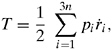
|
where p i = m i  i , m i is the associated mass, i = dr i/ dt and is the velocity in any single coordinate direction. For conservative systems,...
Copyright Cambridge University Press 2005 under license agreement with Books24x7

 TABLE OF CONTENTS