Structural Renovation of Buildings: Methods, Details, and Design Examples
These case studies illustrate the process of upgrading a building's lateral-load-resisting system. The emphasis here is on explaining how and why specific decisions were made by the designers and on illustrating the design process. Some step-by-step calculations are included for relatively uncommon tasks, but the reader is spared routine computations that are familiar to most structural engineers.
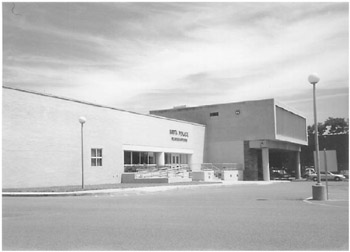
The Massachusetts Bay Transportation Authority (MBTA) needed a new building for its police headquarters. The MBTA police force is a fully accredited and highly professional law-enforcement agency serving the mass-transit system of Boston, Massachusetts, and vicinity. Having outgrown their old building, the police were looking for a new home for their expanded personnel and state-of-the-art equipment. After considering several other locations, the Authority purchased a building in South Boston (Fig. 12.1).
The building, originally designed in 1967 as a meat-packing plant, contained more than an acre of single-story space plus a partial second story. The building had last been used as a commercial printing facility. Maguire Group Inc. (MGI), the design firm selected to develop the renovation program, was able to obtain copies of the original drawings, structural calculations, and foundation data. (This took some detective efforts, mentioned in the beginning of Chap. 2.) In addition to the drawing review and visual inspection, MGI hired a testing agency to conduct an extensive field investigation program. The results of the...