Structural Renovation of Buildings: Methods, Details, and Design Examples
In this section, we conclude our discussion of renovating masonry walls. Masonry includes brick, stone, and CMU. Having already addressed the problems of brick (both solid and veneer) and CMU walls, we will take a closer look at stone-clad buildings. Like brick, stone can be found in two configurations: solid masonry and stone veneer, the ultimate version of which is thin-stone panels.
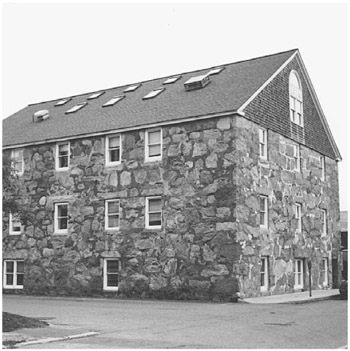
Buildings with stone loadbearing walls were among the very first structures made by humans. Almost all ancient buildings that remain standing today have loadbearing stone masonry exteriors, and many of those have survived in very demanding environments. Figure 13.27 shows an 1836 stone building on the Cape Cod, Massachusetts, waterfront. Despite being exposed to frequent high winds and salt spray, the building is still in use, although it has evidently required many mortar repairs.
The basic processes of stone aging have been known at least since Vitruvius. The causes of stone decay are both natural (weathering and freeze-thaw cycles) and human-made (staining, pollution, application of coatings). With the passage of time, the sharp edges become dull and then are totally washed away as the stone is eroded. The rate of deterioration greatly depends on the type of material, its age,...