Structural Renovation of Buildings: Methods, Details, and Design Examples
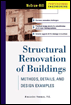
There are two main kinds of brick-veneer walls: those with CMU backing, shown in Fig. 13.12, and those with a backing of steel or wood studs, discussed in Sec. 13.6. Many brick-veneer walls have performed satisfactorily over the years, but others exhibit a multitude of characteristic rainscreen-wall problems ranging from efflorescence to corrosion of the metal ties attaching the brick to the structural backup. Some of these problems are shared by both kinds of brick-veneer walls; others are unique to one or the other.
Brick-veneer walls with CMU backing benefit from the durability and fire resistance of CMU walls as well as from the good water resistance of rainscreen cavity walls. The brick veneer and the blocks are typically connected by horizontal joint reinforcement with integral or adjustable ties; the ties transfer lateral loads between the two wall layers (wythes). The term veneer accurately suggests that the brick's role is that of pure cladding. From a structural standpoint, other materials, such as split-face CMU or stone, can be used as veneer in these walls instead of brick without affecting the design of the CMU backup. However, some designers assume a composite action between the two materials.
The Brick Industry Association (formerly Brick Institute of America),13 differentiates between cavity walls and brick-veneer walls. According to the BIA, cavity walls...