Structural Renovation of Buildings: Methods, Details, and Design Examples
Like all exterior wall materials, brick-veneer walls with either CMU or steel-stud backup can suffer from excessive thermal and moisture movements, veneer disintegration, and water penetration. They can also be damaged by movement of the building structure and settlement of foundations. Of these, repair of brick disintegration is addressed in Sec. 13.4. Repairs of the other problems are discussed in this section.
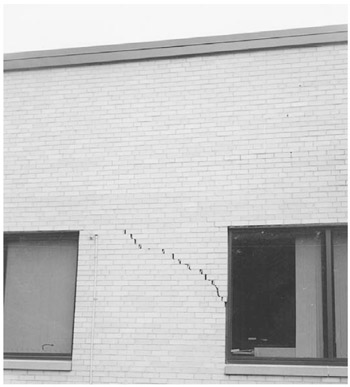
When expansion (relief) joints are not provided or are of insufficient width, brick-veneer walls with either CMU or steel-stud backup can crack. Vertical cracks can occur at such typical locations as wall offsets, setbacks, and corners anywhere the wall movement is restrained. Diagonal cracking may occur at the piers between "punched" windows, where the long expanses of brick above move more than the short piers, and shearing stresses develop at the interface, as shown in Fig. 13.21. (The brick below the windows is restrained by friction against the foundation and tends to move less.) Some other cases of damage attributed to differential movement are
Masonry on exposed concrete foundation walls. When a masonry-clad wall attempts to contract after a temperature chop, the concrete resists this contraction, and the masonry can crack near the corner. Conversely, when the masonry expands more than the concrete wall, which stays at a cooler temperature, a crack at the corner of unreinforced concrete can...