Structural Renovation of Buildings: Methods, Details, and Design Examples
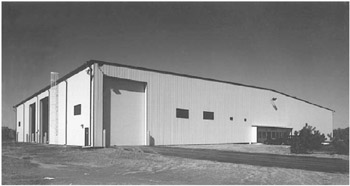
Metal building systems, also known as pre-engineered buildings, are structures designed and fabricated by their manufacturers. These buildings, which are often unassuming and simple in appearance, dominate the low-rise nonresidential market. Metal building systems are found in over two-thirds of all new one- and two-story buildings with areas of up to 150,000 ft 2. In 1997, members of the Metal Building Manufacturers Association (MBMA) covered 388 million ft 2 of space, 46 percent of it in manufacturing applications. Commercial uses, such as warehouses, small office buildings, garages, supermarkets, and retail stores, represented 31 percent of the 1997 sales. Community buildings, among them schools, town halls, and even churches, took 14 percent of the sales, and agricultural and miscellaneous buildings accounted for the rest. Large industrial facilities with areas of over 150,000 square feet added another 41.3 million square feet of new space.1 Figure 10.1 illustrates a typical industrial building with metal building system.
Metal building systems enjoy this popularity because of such advantages as faster occupancy, lower construction cost, flexibility of expansion, easy maintenance, and single-source responsibility. The structure can be custom designed by the manufacturer to fit the project's requirements and minimize material waste. The flip side of this is a certain lack of reserve strength and therefore some difficulty in modifying the framing for new loading conditions. Another problem is the proprietary design of these structures and the variability of design practices among the...