Wireless Broadband Handbook

Chapter 3: Access Techniques for Radio-Based Systems

Some people say that getting there is most of the work. The same holds true with the means of getting either voice or data ready for transmission. Several techniques are available to prepare the information, including the modulation and the access methods. Moreover, the use of simplex or duplex channel capacities plays into the overall structure of the wireless networks. Whereas a voice channel is automatically set up in the telephony world to be full duplex (even if we only use it for a half-duplex operation), the radio world uses the channel differently. We shall analyze these differences in this chapter, not from a selection of better or worse, but from a perspective of the choices available.

Frequency Division Multiple Access (FDMA)

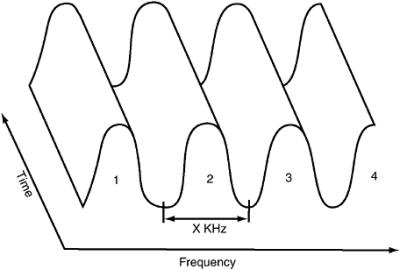
Frequency Division Multiple Access (FDMA) is used for standard analog cellular radio systems. Each user is assigned a discreet slice of the RF spectrum. Therefore, only one user per channel is permitted because it enables the user to occupy the channel 100 percent of the time. As shown in Figure 3-1, the slices vary depending on the standard being used.


Figure 3-1: FDMA channels permit one user per narrowband channel.

Because FDMA uses the full 30-kHz channels for one telephone call at a time, it is obviously wasteful. FDMA, an analog technique, can be improved a little by using the same frequency in a Time Division Duplex (TDD) mechanism. In this mechanism, one channel is used and time slots are created. The conversation flows from...

UNLIMITED FREE
ACCESS
TO THE WORLD'S BEST IDEAS

SUBMIT
Already a GlobalSpec user? Log in.

This is embarrasing...

An error occurred while processing the form. Please try again in a few minutes.

Customize Your GlobalSpec Experience

Category: Wireless Communications Services
Finish!
Privacy Policy

This is embarrasing...

An error occurred while processing the form. Please try again in a few minutes.