Wireless Broadband Handbook

Wireless continues to develop around the world. Several different standards committees are working on integrating wireless architecture into the overall fold of the network.
Get ready! As the convergence of wireless technology and the Internet continue at an escalating pace, the new possibilities created by 3G and 4G technologies appear endless. Preparing for the revolution, existing TDMA operators must evolve their networks to take advantage of Mobile Multimedia applications and the eventual shift to an all-IP architecture. One way to do that is through the evolution of General Packet Radio Services (GPRS). However, soon after we see the installation of GPRS, some operators will begin the next step in the evolution process to Enhanced Data for Global Environment (EDGE). With EDGE, existing TDMA networks can host a variety of new applications, including the following:
Online e-mail
Access to the World Wide Web
Enhanced short message services
Wireless imaging with instant photos or graphics
Video services
Document/information sharing
Surveillance
Voice messaging via Internet
Broadcasting
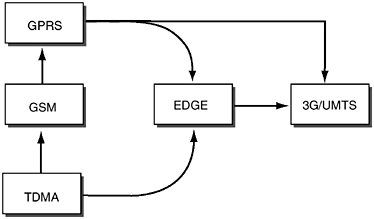
At the same time, some operators will skip the step to EDGE and go directly to Universal Mobile Telecommunications Services (UMTS), or what we consider to be a third-generation (3G) technology. The steps are shown in Figure 10-1, as the carriers choose which way to proceed.
Using a timing window, the evolution of wireless to 3G systems are shown in Figure 10-2, using the...