Analog Circuits: World Class Designs

Chapter 4: Finding the Perfect Op-Amp for Your Perfect Circuit

Bonnie Baker

Overview

Note

"Perfect op-amp"? I just want one that is good enough, and doesn't cost much. /rap

The operational amplifier's operation and circuits are easy to find in the books in your local university library. The amplifier operation and circuit descriptions found in these reference books take you through computational algorithms that theoretically will provide the solutions to your analog amplifier design woes. If there were a perfect amplifier on the market today, the designs found in these books would indeed be easy to implement successfully. But there isn't a perfect amplifier yet. Throughout the history of analog system design, circuits have required special care in key areas in order to ensure success. As luck would have it, a little common sense and bench sense will pull you out of most of your amplifier design disasters.

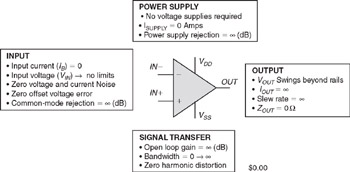
In an ideal world, the perfect amplifier would look like the one described in Figure 4-1


Figure 4-1: A perfect amplifier has an infinite input impedance, open-loop gain, power supply rejection ratio, common-mode rejection ratio, bandwidth, slew rate, and output current. It also has zero offset voltage, input noise, output impedance, power dissipation, and most important, zero cost

The input stage design of this perfect amplifier would use devices whose inputs (IN+ and IN ?) extend all the way to the power supply rails. Some single-supply amplifiers are able to do this with some distortion, but the perfect amplifier would be distortion-free. As a matter of fact, it would be nice if...

UNLIMITED FREE
ACCESS
TO THE WORLD'S BEST IDEAS

SUBMIT
Already a GlobalSpec user? Log in.

This is embarrasing...

An error occurred while processing the form. Please try again in a few minutes.

Customize Your GlobalSpec Experience

Category: Amplifier and Comparator Chips
Finish!
Privacy Policy

This is embarrasing...

An error occurred while processing the form. Please try again in a few minutes.