Analog Circuits: World Class Designs

Bonnie Baker
| Note | Here, Ms. Baker explains what kind of sensors are naturally suitable for what kind of ADC. Will you need preamplifiers, buffers, or filters? Bonnie gives good examples! /rap |
Now that we have the ADC fundamentals out of the way, it's time to do some real work by looking at what these ADCs can do for us. In this chapter, we will spend some time looking at the places where signals come from and which ADC is the best for the application. Through this exercise we will get a better feel of how to prepare the signal for the microcontroller. Once this groundwork is established, we will move into looking at four specific applications. This chapter contains four real-world applications: temperature, pressures, light sensing, and motor control. In these applications, you will have to decide whether a SAR or ??? converter is appropriate. We will discuss the most common ADC problems and then quickly move to solutions. We will find that the SAR converter can service some of these applications. The ??? ADC will better service others. Some applications can utilize both converters, with a minimum number of trade-offs.
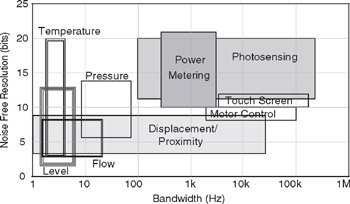
Before we dive into the details of applications, we need to define the origin of real-world analog signals. From there I will show you how to capture those signals with your circuits. Figure 14-1 shows several possible signal sources, with respect to the frequency versus number of bits.