Analog Circuits: World Class Designs

Chapter 8: Noise The Three Categories Device, Conducted, and Emitted

Bonnie Baker

Note

If you haven't bumped into noise problems, perhaps you haven't been looking too closely! Modern solid-state systems almost always have enough noise to see, because even the quietest amplifiers can amplify their noise up to levels that are easy to study. Here Bonnie Baker helps you plan to keep the noise levels down low, despite a whole thicket of (potential) noise generators./rap

Types of Noise

Are your circuits unstable? Or do they tend to give you different results from one moment to the next? Too much noise is a typical problem confronting many circuit designers. In this chapter, noise is defined as undesirable signals that are present in a circuit. This definition excludes analog nonlinearities, which can produce distortion. Once you evaluate where your noise sources are, eliminating circuit noise may be quite simple. Tools such as filters or lower noise devices provide effective solutions. Your circuit board layout will also be critical.

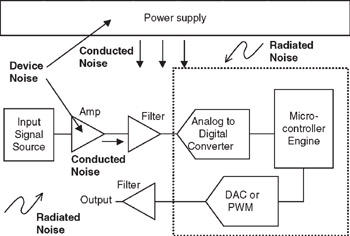
Figure 8-1 shows three primary types of noise found in analog applications. Each type of noise has its own set of possible solutions. The first noise type is device noise. Device noise is the intrinsic noise of the devices in the circuit. Examples of device noise are the thermal noise of a resistor or the shot noise of a transistor. Another type of device noise is the switching noise from a switched mode power supply (inductive based) or a switched capacitor converter (capacitive based).


Figure 8-1: An analog circuit can acquire noise...

UNLIMITED FREE
ACCESS
TO THE WORLD'S BEST IDEAS

SUBMIT
Already a GlobalSpec user? Log in.

This is embarrasing...

An error occurred while processing the form. Please try again in a few minutes.

Customize Your GlobalSpec Experience

Category: Noise Figure Meters
Finish!
Privacy Policy

This is embarrasing...

An error occurred while processing the form. Please try again in a few minutes.