Analog Circuits: World Class Designs

The Key Specifications of Your ADC

Input Range of the ADC

The input range of the ADC can be a bit tricky. You will find variations of single-ended, differential, and pseudo-differential, while the input range is determined by the voltage reference ( V REF) of the converter.

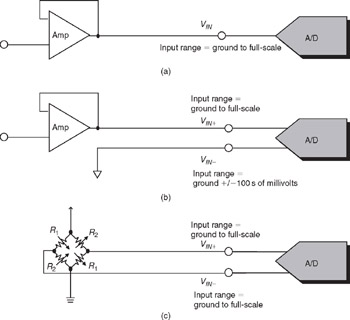
An example of the configuration of an ADC with a single-ended input is shown in Figure 13-1a. This type of converter input is easy to use because there is no question of what to do with that pin. The input voltage range is equal to the full-scale range (FSR) of the converter. Additionally, the digital code at the output of this configuration is straight binary (see the "Straight Binary Code" section later in this chapter).


Figure 13-1: The input(s) of ADCs can be configured in one of three ways. The single-ended input (a) is configured for one input voltage referenced to ground. Another type of input stage has two inputs configured as a pseudo-differential stage (b) where the signal input is the noninverting input and the inverting input is used to reject small-signal system noise. The third type of input stage is the differential input (c) where the two inputs to the converter range from ground to the full-scale input voltage

In Figure 13-1b, the input of the converter is configured as a pseudo-differential input. This simply means that the input to the converter is differential, but one of the input pins has a range that is limited to a...

UNLIMITED FREE
ACCESS
TO THE WORLD'S BEST IDEAS

SUBMIT
Already a GlobalSpec user? Log in.

This is embarrasing...

An error occurred while processing the form. Please try again in a few minutes.

Customize Your GlobalSpec Experience

Category: Signal Converters
Finish!
Privacy Policy

This is embarrasing...

An error occurred while processing the form. Please try again in a few minutes.