Elementary Fluid Mechanics

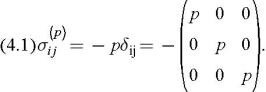
In the previous chapters, we learned the existence of surface forces to describe fluid motion in addition to the volume force such as gravity. The surface force is also termed as the stress and represented by a tensor. A typical stress is the pressure p ? ij, [1] which is written as
The pressure force acts perpendicularly to a surface element ?A( n) and is represented as ? pn id A (see (2.8), (2.9)). Another stress was the viscous stress (internal friction)
considered in Sec. 2.6, which has a tangential force to the surface ?A( n) as well. A typical one is the shear stress in the parallel shear flow in Sec. 2.5.
The conservation of momentum of flows of an ideal fluid is given by (3.21) and (3.22), which reads
where P ik = ?v i v k + p ? ik is the momentum flux tensor for an ideal-fluid flow. In order to obtain the equation of motion of a viscous fluid, a viscous stress should be added to the ideal momentum flux P ik, which is written as
representing irreversible viscous transfer of momentum. [2] Thus we write the momentum flux tensor in a viscous fluid in the form,
where ? ij is the stress tensor written as q ij in Sec. 2.4, and ![]()