Elementary Fluid Mechanics

Problem 9

problem 9.1

Rayleigh Taylor instability

Suppose that a heavy fluid of constant density ? 1 is placed above a light fluid of another constant density ? 2, and separated by a surface S in a vertically downward gravitational field of acceleration g. In the unperturbed state, the surface S was a horizontal plane located at y = 0 (with the y axis taken vertically upward) and the fluid was at rest, and the density was


Suppose that the surface S is deformed in the form,


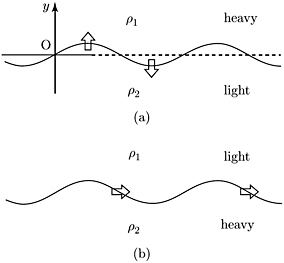
[Fig. 9.9(a)]. Both above and below S, the flow is assumed to be irrotational and the velocity potential is expressed as


  1. Derive linear perturbation equations for small perturbations ?, and from the boundary conditions (6.8) and (6.10).

  2. Expressing the perturbations in the following forms with a growth rate ? and a wavenuumber k,


    derive an equation to determine the growth rate ?, where A, B 1 , B 2 are constants. State whether the basic state is stable or unstable.

  3. Apply the above analysis to the case where a lighter fluid is placed above a heavy fluid, and derive a conclusion that there exists an interfacial wave (called the internal gravity wave, Fig. 9.9(b)). State what is the frequency.


Figure 9.9: (a) Rayleigh Taylor instability, (b) internal gravity wave.

problem 9.2

Rayleigh s inflexion-point theorem

Based on the Rayleigh s equation (9.23) or (9.26), verify the followings:

UNLIMITED FREE
ACCESS
TO THE WORLD'S BEST IDEAS

SUBMIT
Already a GlobalSpec user? Log in.

This is embarrasing...

An error occurred while processing the form. Please try again in a few minutes.

Customize Your GlobalSpec Experience

Category: Globe Valves
Finish!
Privacy Policy

This is embarrasing...

An error occurred while processing the form. Please try again in a few minutes.