Elementary Fluid Mechanics

If a vector field v( x) is irrotational at all points x = ( x, y, z) of an open simply-connected domain D under consideration, v satisfies the equation, curl v = 0. Then there exists a scalar function ?( x) for x ? D such that v( x) is represented as
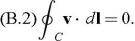
In fact, if curl v = 0, we have from Stokes s theorem (A.35) of Appendix A,
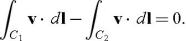
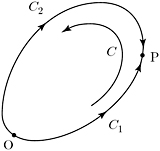
Taking two points O and P on the oriented closed curve C (Fig. B.1), the curve C is divided into two parts C 1 ( O to P, say) and C ? C 1 ( P to O). Reversing the orientation of C ? C 1 and writing its reversed curve as C 2, the above equation becomes
(The minus sign of the second term corresponds to interchanging both ends x 1 and x 2 in the line integral (A.34).) This can be written as
The closed curve C can be chosen arbitrarily within the domain of irrotationality. Hence in the above expression, the integral path from O to P can be taken arbitrarily in D, and the integral is regarded as a function of the end points O and P only, which...