Elementary Fluid Mechanics

Problem 4

problem 4.1

Hagen Poiseuille flow

  1. Using the cylindrical coordinates ( x, r, ?) (Appendix D.2, by rearranging from ( r, ?, z) to ( x, r, ?)), show that Eq. (4.39) can be written as


  2. Suppose that a steady parallel viscous flow is maintained in a circular pipe of radius a under a constant pressure gradient grad p = ( ? P, 0 , 0) with P > 0 in the x-direction, so that Eq. (4.77) is valid. Assuming that u = u( r), derive the following velocity profile,


    (Hagen, 1839 and Poiseuille, 1840).

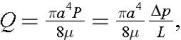
  3. Show that the total rate of flow Q per unit time is given by


    where ?p is the magnitude of pressure drop along the length L : P = ? p/L. [Note that Q ? a 4 / ?.]

problem 4.2

Oscillating boundary layer

Suppose that the plane wall y = 0 is oscillating with velocity U w( t) and angular frequency ? in its own plane with: U w = U cos ?t, and that velocity u of a viscous fluid in space y > 0 is subject to Eq. (4.44). Show that the solution decaying at infinity is given by


(Fig. 4.8). In addition, express a representative thickness ? of the oscillating boundary layer in terms of ? and...

UNLIMITED FREE
ACCESS
TO THE WORLD'S BEST IDEAS

SUBMIT
Already a GlobalSpec user? Log in.

This is embarrasing...

An error occurred while processing the form. Please try again in a few minutes.

Customize Your GlobalSpec Experience

Category: Industrial Valves
Finish!
Privacy Policy

This is embarrasing...

An error occurred while processing the form. Please try again in a few minutes.