Coating Materials for Electronic Applications: Polymers, Processes, Reliability, Testing

Acrylics are the most widely used coatings for the protection of printed wiring boards due to a combination of low cost, excellent electrical insulation properties, moisture protection, and ease of repair.
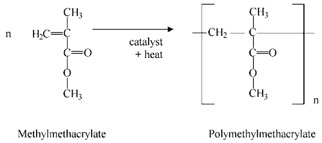
Acrylics used as conformal coatings are generally polymethylmethacrylates formed from methylmethacrylate monomers that polymerize on exposure to air with a catalyst at room temperature or on heating. Figure 2.1, for example, shows the basic chemistry involved in the formation of polymethylmethacrylate. The reaction is an addition type in which the double bond is decoupled to form transient free radicals which quickly unite to form the polymer. Properties can be changed by varying the methyl groups or by copolymerizing with other resins containing a double bond. Most acrylic coatings used as conformal coatings are solutions of prepolymerized acrylates, for example, polymethylmethacrylates (PMMA). Thus, no further polymerization occurs after coating. Solidification and adhesion to the substrate occur by evaporation of the solvent and drying. Total evaporation of the solvent is important to achieve the optimum physical and electrical properties.
The acrylic group can be incorporated in other polymer types to render them photosensitive or to alter their properties through cross-linking. Acrylate groups, for example, have been appended to epoxies, silicones, polyurethanes, and fluorocarbons to produce photosensitive formulations.
Acrylics are thermoplastic polymers noted for their excellent optical characteristics and resistance to outdoor environments. Acrylic coatings are used in many optical applications where their high light transmittance of 92% and...