Coating Materials for Electronic Applications: Polymers, Processes, Reliability, Testing

2.5: DIALLYLPHTHALATE AND OTHER ALLYLIC POLYMERS

2.5 DIALLYLPHTHALATE AND OTHER ALLYLIC POLYMERS

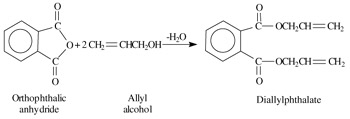
Polymers based on diallylphthalate or those derived from monomers containing the functional allylic group -CH 2-CH=CH 2 are referred to as allylic polymers. They may also be regarded as a specific class of polyesters or as a class of vinyls. Diallylphthalate, the simplest and most commonly used monomer, is an ester of orthophthalic acid and allyl alcohol. In its synthesis (Fig. 2.7), the orthophthalic anhydride may be employed instead of the acid. Other commonly used ester monomers include diallylisophthalate, triallylcyanurate, diallylmaleate, and diallylchlorendate.


Figure 2.7: Synthesis of diallylphthalate monomer.

All allylic polymers are formed by a free-radical addition-type polymerization that occurs through the vinyl groups in a manner similar to the polymerization of styrene or other vinyl monomers. As such, no by-products are released during polymerization. A large variety of polymers and copolymers is possible, depending on the monomers used. However, the diallylphthalates and diallylisophthalates are the ones most used as coatings, varnishes, and impregnants. Diallylphthalates possess excellent electrical properties, chemical resistance, and thermal stability. The triallylcyanurate polymer is reported to be stable up to 300 C.[8] Among limitations are the high shrinkages that occur during polymerization; up to 12% has been reported.

UNLIMITED FREE
ACCESS
TO THE WORLD'S BEST IDEAS

SUBMIT
Already a GlobalSpec user? Log in.

This is embarrasing...

An error occurred while processing the form. Please try again in a few minutes.

Customize Your GlobalSpec Experience

Category: Monomers, Intermediates, and Base Polymers
Finish!
Privacy Policy

This is embarrasing...

An error occurred while processing the form. Please try again in a few minutes.