Coating Materials for Electronic Applications: Polymers, Processes, Reliability, Testing

Parylene (p-polyxylylene) coatings represent a unique class in their ability to be polymerized and deposited by vapor deposition onto surfaces maintained at room temperature. Extremely thin, pinhole-free, high purity coatings are deposited that fulfill many of the requirements of advanced microelectronics. As such, they continue to find new applications in space, medical, and other high-reliability electronics.
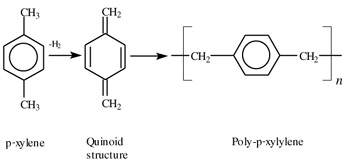
Poly-p-xylylene films were first synthesized by the pyrolytic dehydrogenation of gaseous p-xylene. In this rather drastic process, p-xylene was subjected to very high cracking temperatures of 700 1100 C at a reduced pressure of 1 5 torr, whereupon it lost a molecule of hydrogen and converted to an unstable quinoid compound. On quenching, this quinoid structure polymerized rapidly to yield the desired poly-p-xylylene film. [71] [73] This process found little practical use because of the high temperatures that were required. Furthermore, the resulting films were infusible and intractable (Fig. 2.53). In 1965, a simplified process for preparing a series of polyp-xylylenes that were completely linear polymers was developed by Gorham at Union Carbide. [74] [75] Parylenes, Union Carbide's tradename for their high-purity p-polyxylylenes, were introduced for commercial applications in 1966.
Parylenes have the distinction of being the only polymer coatings that can be vapor deposited on a commercial scale by the thermal decomposition of a solid dimer. The first step in the process consists of heating the solid dimer (di-p-xylene) at approximately 150 C and 1 torr whereupon it sublimes. The gaseous dimer then passes through a...