Coating Materials for Electronic Applications: Polymers, Processes, Reliability, Testing

Polyvinyls are among the oldest types of polymers and consist of many structural variations. However, lacking either thermal stability or stable electrical properties under severe stresses, they are seldom used as protective or dielectric coatings, especially for the more advanced electronics. Among the most widely used polyvinyls are the polyvinyl chlorides and polyvinyl formal (Formvar) used as wire insulation.
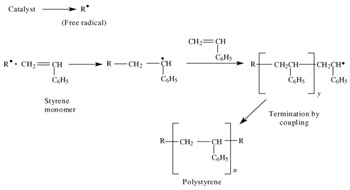
Vinyl polymers are prepared by the free-radical addition polymerization of monomers containing one or more double bonds. The monomers join head-to-tail to form long-chain linear polymers of high molecular weight without releasing any by-products. Ultraviolet light, heat, or catalysts are used to initiate the free-radical reaction. The best accelerators are peroxide catalysts such as benzoyl peroxide or dicumyl hydroperoxide. For example, the polymerization mechanism for styrene (a vinyl benzene) using a catalyst is shown in Fig. 2.5.
Included in the vinyl classifications are many well-known monomers and their associated polymers as listed in Table 2.3. Most of these polymers are formed directly from the polymerization of the vinyl monomer without further alteration and are referred to as primary vinyls. Others, formed by subsequently reacting the primary vinyls with reagents that alter the groups along the polymer chain, are called secondary vinyl resins. For example, some of the acetate groups of polyvinyl acetate may be hydrolyzed, and the resulting hydroxy groups then co-reacted with aldehydes to yield acetal derivatives. There are three such derivatives of importance to the electronics...