Coating Materials for Electronic Applications: Polymers, Processes, Reliability, Testing

Epoxy resins form the basis for a wide variety of polymer materials used in electronics ranging from conformal coatings to adhesives, encapsulants, and printed wiring board laminates. The extensive use of epoxies is due to their combination of low cost, ease of processing, and excellent thermal, electrical, mechanical, and moisture barrier properties. However, because of the numerous formulations possible and available from different vendors, there can be wide variations in their properties. Epoxies were initially developed in the early 1930s, but production for commercial applications did not begin until the 1950s. Initially, epoxy resins were developed and promoted by Ciba and the Shell Chemical Company. Today there are numerous manufacturers and formulators. Since 1960, epoxies have been formulated and applied to the rapidly growing field of electronics. They are widely used as die-attach adhesives, laminates for printed wiring boards, conformal coatings, encapsulants, underfill adhesives for flip-chip and ball-grid-array modules, glob-top encapsulants, and transfer molding compounds for PEMs (plastic encapsulated microcircuits).
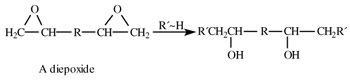
Epoxies are based on the high reactivity of the strained three-member epoxy ring, also referred to as the oxirane ring. When mixed with acidic or alkaline compounds or with compounds that contain labile hydrogen atoms, the epoxy rings open up and a polymerization reaction occurs, resulting in useful epoxy coatings, adhesives encapsulants, and laminates (Fig. 2.8). Besides the epoxy group, the pendant hydroxyl groups of an epoxy resin are also reactive. Further cross-linking or lengthening of the polymer chain occurs through these groups.