RF Circuit Design, Second Edition

Chapter 4: Impedance Matching

OVERVIEW

Impedance matching is often necessary in the design of RF circuitry to provide the maximum possible transfer of power between a source and its load. Probably the most vivid example of the need for such a transfer of power occurs in the front end of any sensitive receiver. Obviously, any unnecessary loss in a circuit that is already carrying extremely small signal levels simply cannot be tolerated. Therefore, in most instances, extreme care is taken during the initial design of such a front end to make sure that each device in the chain is matched to its load.

In this chapter, then, we will study several methods of matching a given source to a given load. This will be done numerically, with the aid of the Smith Chart, and by using software design tools. In all cases, exact step-by-step procedures will be presented, making any calculations as painless as possible.

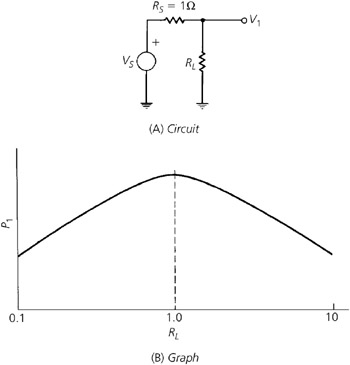
Proof that P out MAX occurs when R L = R s, in the circuit of Fig. 4-1A, is given by the formula:


FIG. 4-1: The power theorem.

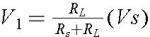
Set V s =1 and R s =1, for convenience. Therefore,


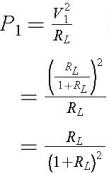
Then, the power into R L is:


If you plot P 1 versus R L, as in the preceding equation, the result is shown by the curve of the graph in Fig. 4-1B.

BACKGROUND

There is a well-known theorem which states that, for DC circuits, maximum power will be transferred...

UNLIMITED FREE
ACCESS
TO THE WORLD'S BEST IDEAS

SUBMIT
Already a GlobalSpec user? Log in.

This is embarrasing...

An error occurred while processing the form. Please try again in a few minutes.

Customize Your GlobalSpec Experience

Category: Impedance Matching Networks
Finish!
Privacy Policy

This is embarrasing...

An error occurred while processing the form. Please try again in a few minutes.