RF Circuit Design, Second Edition

FREQUENCY AND IMPEDANCE SCALING

Once you specify the filter, choose the appropriate attenuation response, and write down the low-pass prototype values, the next step is to transform the prototype circuit into a usable filter. Remember, the cutoff frequency of the prototype circuit is 0.159 Hz ( ? = 1 rad/sec), and it operates between a source and a load resistance that are normalized so that R L = 1 ohm.

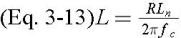
The transformation is effected through the following formulas:


and


where

  • C = the final capacitor value,

  • L = the final inductor value,

  • C n = a low-pass prototype element value,

  • L n = a low-pass prototype element value,

  • R = the final load resistor value,

  • f c = the final cutoff frequency.

The normalized low-pass prototype source resistor must also be transformed to its final value by multiplying it by the final value of the load resistor (Example 3-5). Thus, the ratio of the two always remains the same.

Example 3-5

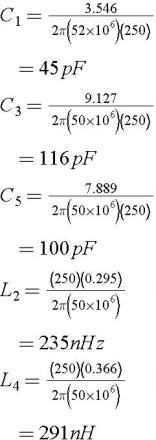
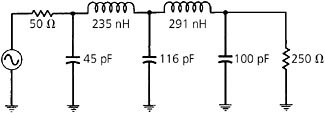
Scale the low-pass prototype values of Fig. 3-19 (Example 3-4) to a cutoff frequency of 50 MHz and a load resistance of 250 ohms.

Solution

Use Equations 3-12 and 3-13 to scale each component as follows:


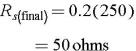
The source resistance is scaled by multiplying its normalized value by the final value of the load resistor.


The final circuit appears in Fig. 3-21.


FIG. 3-21: Low-pass filter circuit for Example 3-5.

The process for designing a low-pass filter is a very simple one...

UNLIMITED FREE
ACCESS
TO THE WORLD'S BEST IDEAS

SUBMIT
Already a GlobalSpec user? Log in.

This is embarrasing...

An error occurred while processing the form. Please try again in a few minutes.

Customize Your GlobalSpec Experience

Category: Active Low Pass Filters
Finish!
Privacy Policy

This is embarrasing...

An error occurred while processing the form. Please try again in a few minutes.