RF Circuit Design, Second Edition

Thus far, we have been referring to the group of low-pass prototype element value tables presented, and then we choose the schematic that is located either above or below the tables for the form of the filter that we are designing, depending on the value of R L/ R s. Either form of the filter will produce exactly the same attenuation, phase, and group-delay characteristics, and each form is called the dual of the other.
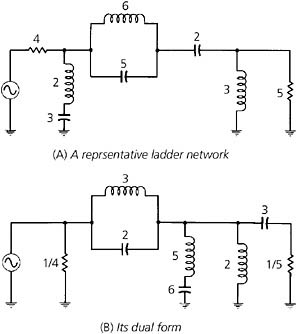
Any filter network in a ladder arrangement, such as the ones presented in this chapter, can be changed into its dual form by application of the following rules:
Change all inductors to capacitors, and vice-versa, without changing element values. Thus, 3 henries becomes 3 farads.
Change all resistances into conductances, and vice-versa, with the value unchanged. Thus, 3 ohms becomes 3 mhos, or 1/3 ohm.
Change all shunt branches to series branches, and vice versa.
Change all elements in series with each other into elements that are in parallel with each other.
Change all voltage sources into current sources, and vice versa.
Fig. 3-26 shows a ladder network and its dual representation.
Dual networks are convenient, in the case of equal terminations, if you desire to change the topology of the filter without changing the response. It is most often used, as shown in Example 3-7, to eliminate an unnecessary inductor which might have crept into the design...