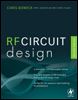
RF Circuit Design, Second Edition

Appendix A: RF and Antennas

WHAT IS RF?

RF design is affected by residual circuit values, such as additional capacitances and inductances, exhibited even by transmission lines and circuit traces at high-enough frequencies. These residual or parasitic circuit elements can even be found in the structures of transistors used for RF and microwave frequencies.

At lower frequencies, the physical wavelengths of signals are very large so that the size of electrical components has little impact on these signals. For example, the very-low-frequency (VLF) range, which encompasses much of the human hearing range of 20 Hz to 20 kHz, features signals with wavelengths as long as 100 km (3 kHz). The high-frequency (HF) band, with frequencies from 3 to 30 MHz and wavelengths from 100 to 10 m, has long been used for military tactical radios and for amateur ( ham ) radio operators (the 30-m or 10-MHz range) for the long-distance propagation properties of the waves.

Signals in the very-high-frequency (VHF) range of 30 to 300 MHz and the ultra-high-frequency (UHF) range of 300 MHz to 3 GHz have long been used for television broadcast, although in recent decades the 800- and 900-MHz bands are better known for use by cellular and cordless telephones. As cellular telephones have migrated to higher-frequency use in the bands around 1900 through 2100 MHz, additional wireless applications have grown in spot frequencies such as 2450 MHz, such as wireless local area networks (WLANs) and Bluetooth . The over-used frequency is also the designated frequency for industrial heating and microwave ovens,...

UNLIMITED FREE
ACCESS
TO THE WORLD'S BEST IDEAS

SUBMIT
Already a GlobalSpec user? Log in.

This is embarrasing...

An error occurred while processing the form. Please try again in a few minutes.

Customize Your GlobalSpec Experience

Category: Radio Transmitter ICs
Finish!
Privacy Policy

This is embarrasing...

An error occurred while processing the form. Please try again in a few minutes.