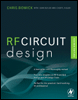
RF Circuit Design, Second Edition

In Chapter 1, we discussed resistors, capacitors, and inductors, and their behavior at radio frequencies. We found that, when working at higher frequencies, we could no longer think of a capacitor as just a capacitor, or an inductor as a perfect inductor. In fact, each of these components can be represented by an equivalent circuit that indicates just how imperfect that component really is.
In this chapter, we will find that the transistor, too, is an imperfect device whose characteristics also vary with frequency. Therefore, the equivalent circuit for a typical transistor is introduced and analyzed. Then, with the aid of the equivalent circuit, the input, output, feedback, and gain characteristics are described. We will then examineY and S parameters and take a look at how manufacturers typically present the transistor s characteristics on their data sheets.
Transistor-level design remains an important part of RF design, even though today s analog and RF engineers live in a world of connect the IC boxes. There are a number of key reasons why transistor level design while it may be more difficult and require more time than merely connected IC modules can be well worth the extra effort. Some of these reasons include:
Exploration of design options Working at the transistor level allows the engineer to explore all possible design options at a powerful device level.
Methodologies The engineer can take advantage of emerging automated design tools and methodologies to speed the design process and make it much more effective.
Results Putting in the higher...