RF Circuit Design, Second Edition

Once you have learned the mechanics of low-pass filter design, high-pass design becomes a snap. You can use all of the attenuation response curves presented, thus far, for the low-pass filters by simply inverting the will produce an attenuation of about 60 dB at an f / f c of 3 (Fig. 3-16). If you were working instead with a high-pass filter of the same size and type, you could still use Fig. 3-16 to tell you that at an f / f c of 1/3 (or, f c/ f = 3) a 5-element, 0.1-dB-ripple Chebyshev high-pass filter will also produce an attenuation of 60 dB. This is obviously more convenient than having to refer to more than one set of curves.
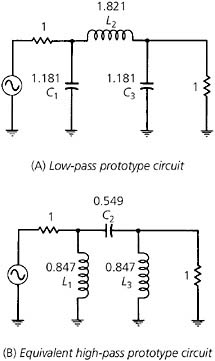
After finding the response that satisfies all of the requirements, the next step is to simply refer to the tables of low-pass prototype values and copy down the prototype values that are called for. High-pass values for the elements are then obtained directly from the low-pass prototype values as follows (refer to Fig. 3-24):
Simply replace each filter element with an element of the opposite type and with a reciprocal value. Thus, L 1 of Fig. 3-24B is equal to 1/ C 1 of Fig. 3-24A. Likewise, C 2 = 1/ L 2 and L 3 = 1/ C 3. Stated another way, if...