RF Circuit Design, Second Edition

The low-pass prototype circuits and response curves given in this chapter can also be used in the design of bandpass filters. This is done through a simple transformation process similar to what was done in the high-pass case.
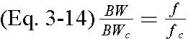
The most difficult task awaiting the designer of a bandpass filter, if the design is to be derived from the low-pass prototype, is in specifying the bandpass attenuation characteristics in terms of the low-pass response curves. A method for doing this is shown by the curves in Fig. 3-27. As you can see, when a low-pass design is transformed into a bandpass design, the attenuation bandwidth ratios remain the same. This means that a low-pass filter with a 3-dB cutoff frequency, or a bandwidth of 2 kHz, would transform into a bandpass filter with a 3-dB bandwidth of 2 kHz. If the response of the low-pass network were down 30 dB at a frequency or bandwidth of 4 kHz ( f / f c = 2), then the response of the bandpass network would be down 30 dB at a bandwidth of 4 kHz. Thus, the normalized f / f c axis of the low-pass attenuation curves becomes a ratio of bandwidths rather than frequencies, such that:
where
BW = the bandwidth at the required value of attenuation,
BW c = the 3-dB bandwidth of the bandpass filter.
Often a...