Mechanics of Composite Materials with MATLAB

Written specifically for students in engineering and materials science, this text places emphasis on learning the composite material mechanics computations and on understanding the underlying concepts.
 TABLE OF CONTENTS
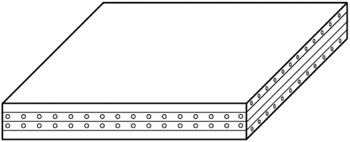
 Fiber-reinforced materials consist usually of multiple layers of material to form a laminate. Each layer is thin and may have a different fiber orientation see Fig. 7.1. Two laminates may have the same number of layers and the same fiber angles but the two laminates may be different because of the arrangement of the layers.
In this chapter, we will evaluate the influence of fiber directions, stacking arrangements and material properties on laminate and structural response. We will study a simplified theory called classical lamination theory for this purpose (see [1]).
Figure 7.2 shows a global Cartesian coordinate system and a general laminate consisting of N layers. The laminate thickness is denoted by H and the thickness of an individual layer by h. Not all layers necessarily have the same thickness, so the thickness of the kth layer is denoted by h k.
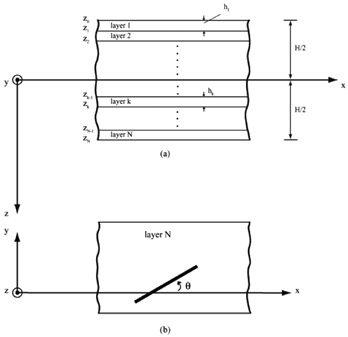
The origin of the through-thickness coordinate, designated z, is located at the laminate geometric midplane. The geometric midplane may be within a particular layer or at an interface between layers. We consider the + z axis to be downward and the laminate extends in the z direction from - H/2 to + H/2. We refer to the layer at the most negative location as layer 1, the next layer in...