Mechanics of Composite Materials with MATLAB

Written specifically for students in engineering and materials science, this text places emphasis on learning the composite material mechanics computations and on understanding the underlying concepts.
 TABLE OF CONTENTS
In this chapter we present various failure theories for one single layer of the composite laminate, usually called a lamina. We use the following notation throughout this chapter for the various strengths or ultimate stresses:
 : tensile strength in longitudinal direction.
 : compressive strength in longitudinal direction.
 : tensile strength in transverse direction.
 : compressive strength in transverse direction.
 : shear strength in the 1-2 plane.
where the strength means the ultimate stress or failure stress, the longitudinal direction is the fiber direction (1-direction), and the transverse direction is the 2-direction (perpendicular to the fiber).
We also use the following notation for the ultimate strains:
 : ultimate tensile strain in the longitudinal direction.
 : ultimate compressive strain in the longitudinal direction.
 : ultimate tensile strain in the transverse direction.
 : ultimate compressive strain in the transverse direction.
 : ultimate shear strain in the 1-2 plane.
It is assumed that the lamina behaves in a linear elastic manner. For the longitudinal uniaxial loading of the lamina (see Fig. 10.1), we have the following elastic relations:
| (10.1) |  |
| (10.2) |  |
where E 1 is Young's modulus of the lamina in the longitudinal (fiber) direction.
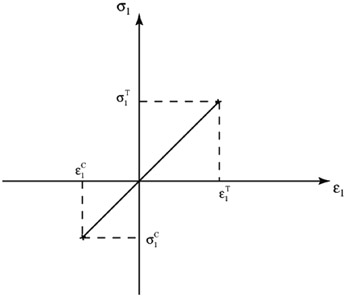
For the transverse uniaxial loading of the lamina (see Fig. 10.2), we have the following elastic relations:
| (10.3) |  |
| (10.4) |  |
where E 2 is Young's modulus of the lamina in the transverse direction. For...