Mechanics of Composite Materials with MATLAB

Written specifically for students in engineering and materials science, this text places emphasis on learning the composite material mechanics computations and on understanding the underlying concepts.
 TABLE OF CONTENTS
 The engineering properties or elastic constants were introduced in Chap. 2 with respect to the lamina 1-2-3 coordinate system. Their evaluation was presented in Chap. 3 based also on the 1-2-3 coordinate system. We can also define elastic constants with respect to the x- y- z global coordinate system. The elastic constants in the x- y- z coordinate system can be derived directly from their definitions, just as they were derived in Chap. 3 for the 1-2-3 coordinate system.
The elastic constants based on the x- y- z global coordinate system are given as follows [1]:
| (6.1) | 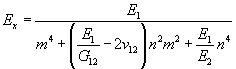 |
| (6.2) | 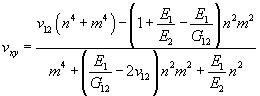 |
| (6.3) | 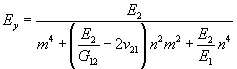 |
| (6.4) | 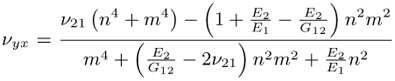 |
| (6.5) | 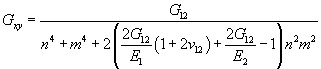 |
It is useful to define several other material properties for fiber-reinforced composite materials that can be used to categorize response [1]. These properties have as their basis the fact that an element of fiber-reinforced composite material with its fiber oriented at some arbitrary angle exhibits a shear strain when subjected to a normal stress, and it also exhibits an extensional strain when subjected to a shear stress.
Poisson's ratio is defined as the ratio of extensional strains, given that the element is subjected only to a simple normal stress. By analogy, the coefficient of mutual influence of the second kind is defined as the ratio of a shear strain to an extensional strain, given that the element is subjected to only a single normal stress. The coefficient of mutual influence of the first kind is...