9.1 Basic Equations
In this chapter, we introduce the concept of effective elastic constants for the laminate. These constants are the effective extensional modulus in the x direction E x, the effective extensional modulus in the y direction E y, the effective Poisson's ratios v xy and v yx, and the effective shear modulus in the x- y plane G xy.
The effective elastic constants are usually defined when considering the inplane loading of symmetric balanced laminates. In the following equations, we consider only symmetric balanced or symmetric cross-ply laminates. We therefore define the following three average laminate stresses [1]:
| (9.1) | 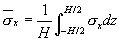
|
| (9.2) | 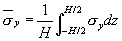
|
| (9.3) | 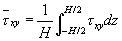
|
where H is the thickness of the laminate. Comparing (9.1), (9.2), and (9.3) with (7.13), we obtain the following relations between the average stresses and the force resultants:
| (9.4) | 
|
| (9.5) | 
|
| (9.6) | 
|
Solving (9.4), (9.5), and (9.6) for N x, N y, and N xy, and substituting the results into (8.11) and (8.12) for symmetric balanced laminates, we obtain:
| (9.7) | 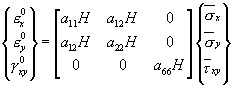
|
The above 3 3 matrix is defined as the laminate compliance matrix for symmetric balanced laminates. Therefore, by analogy with (4.5), we obtain the following effective elastic constants for the laminate:
| (9.8a) | 
|
| (9.8b) | 
|
| (9.8c) | 
|
| (9.8d) | 
|
| (9.8e) | 
|
It is clear from the above equations that v xy and v yx are not independent and are related by the following reciprocity relation:
| (9.9) | 
|
Finally, we note that the expressions of the effective...

 TABLE OF CONTENTS