Mechanics of Composite Materials with MATLAB

Written specifically for students in engineering and materials science, this text places emphasis on learning the composite material mechanics computations and on understanding the underlying concepts.
 TABLE OF CONTENTS
 In the analysis of fiber-reinforced composite materials, the assumption of plane stress is usually used for each layer (lamina). This is mainly because fiber-reinforced materials are utilized in beams, plates, cylinders, and other structural shapes which have at least one characteristic geometric dimension in an order of magnitude less than the other two dimensions. In this case, the stress components ? 3, ? 23, and ? 13 are set to zero with the assumption that the 1-2 plane of the principal material coordinate system is in the plane of the layer (lamina) - see [1]. Therefore, the stresses ? 1, ? 2, and ? 12 lie in a plane, while the stresses ? 3, ? 23, and ? 13 are perpendicular to this plane and are zero (see Fig. 4.1).
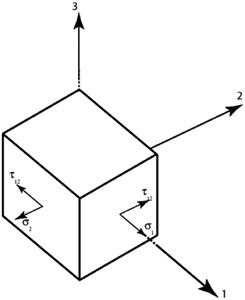
Using the assumption of plane stress, it is seen that the stress-strain relations of Chap. 2 are greatly simplified. Setting ? 3 = ? 23 = ? 13 = 0 in (2.1) leads to the following:
| (4.1) | 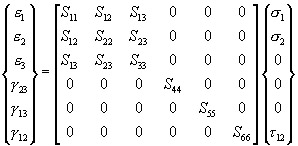 |
As a result of the plane stress assumption and using (4.1), we conclude that:
| (4.2) |  |
| (4.3) |  |
| (4.4) |  |
Therefore (4.1) reduces to the following equation:
| (4.5) | 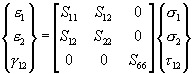 |
The 3 3 matrix in (4.5) is called the reduced compliance matrix. The inverse of the reduced compliance matrix is the reduced stiffness matrix given as...