Mechanics of Composite Materials with MATLAB

Written specifically for students in engineering and materials science, this text places emphasis on learning the composite material mechanics computations and on understanding the underlying concepts.
 TABLE OF CONTENTS
 In this chapter, we will refer the response of each layer (lamina) of material to the same global system. We accomplish this by transforming the stress-strain relations for the lamina 1-2-3 coordinate system into the global coordinate system. This transformation will be done for the state of plane stress using the standard transformation relations for stresses and strains given in introductory courses in mechanics of materials [1].
Consider an isolated infinitesimal element in the principal material coordinate system (1-2-3 system) that will be transformed into the x- y- z global coordinate system as shown in Fig. 5.1. The fibers are oriented at angle ? with respect to the + x axis of the global system. The fibers are parallel to the x- y plane and the 3 and z axes coincide. The orientation angle ? will be considered positive when the fibers rotate counterclockwise from the + x axis toward the + y axis.
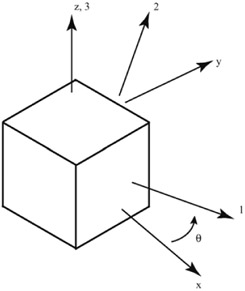
The stresses on the small volume of element are now identified with respect to the x- y- z system. The six components of stress are now ? x, ? y, ? z, ? yz, ? xz, and ? xy, while the six components of strain are ? x, ? y, ? z, ? yz, ?