Go to GlobalSpec.com Home
Toolbar   The Engineering Toolbar
The Ultimate Resource for Engineering and Technical Research. (Learn More)

Chapter 4: Design Characteristics

By Meherwan P. Boyce
From Centrifugal Compressors: A Basic Guide
OVERVIEW

Centrifugal compressors are used extensively because of their smooth operation, large tolerance of process fluctuations, and their higher reliability compared to other types of compressors. Centrifugal compressors range in size from pressure ratios of 1:3 per stage to as high as 12:1 on experimental models. The selection of this type of compressor is prevalent in the petrochemical industry. The proper selection of a compressor is a complex and important decision. The successful operation of many plants depends on smooth and efficient compressor operations. To ensure the best selection and proper maintenance of a centrifugal compressor, the engineer must have knowledge of many engineering disciplines.

Centrifugal compressors in general are used for higher-pressure ratios and lower-flow rates compared to lower-stage pressure ratios and higher-flow rates in axial compressors.

Figure 4-1 is a map for centrifugal compressors that shows the effect of specific speed (N s) and specific diameter (D s) on their efficiency. The most efficient region for centrifugal compressor operation is in a specific speed range between 60 s> 1,500. Specific speeds of more than 3,000 usually require an axial-flow-type compressor. In a centrifugal compressor the angular momentum of the gas flowing through the impeller is increased partly because the impeller's outlet diameter is significantly greater than its inlet diameter. The major difference between axial and centrifugal compressors is the variance in the diameters of the inlet and the outlet. The flow leaving the centrifugal compressor is usually perpendicular to the axis of rotation.
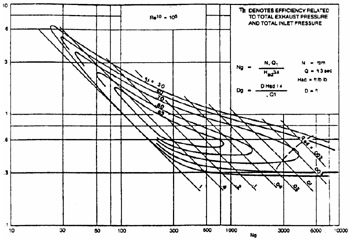

Figure 4-1:
Copyright Penn Well Corporation 2003 under license agreement with Books24x7

Products & Services
Gas compressors and gas compressor systems are used to circulate gas through a process, enhance conditions for chemical reactions, provide inert gas for safety or control systems, recover and recompress process gas, and maintain correct pressure levels by either adding and removing gas or vapors from a process system. Search by Specification | Learn more about Gas Compressors and Gas Compressor Systems
Air compressors are machines that compress air to higher than atmospheric pressures for delivery to pneumatic or robotic tools, industrial equipment, or direct-use applications. Search by Specification | Learn more about Air Compressors
Turbine pumps are centrifugal pumps that use pressure in combination with a rotary mechanism to transfer fluid.  They typically employ blade geometry, which causes fluid circulation around the vanes to add pressure from inlet to outlet.  Search by Specification | Learn more about Turbine Pumps
Cyclone separators and centrifugal separators utilize centrifugal, gravitational, and inertial forces to remove fine particles suspended in air or gas. Search by Specification | Learn more about Cyclone Separators
Centrifugal pumps consist of a set of rotating vanes, enclosed within a housing or casing, that are used to impart energy to a fluid through centrifugal force. Search by Specification | Learn more about Centrifugal Pumps

Product Announcements
Cameron’s Compression Systems - Two Stage 250-400HP Oil Free Plant Air Compressor
Say goodbye to costly screw airends and welcome to Cameron's Turbo-Air® 2020, the ideal centrifugal package that leaves today's dry screw and other centrifugal compressors far behind. Named "2005... (read more)
Cameron’s Compression Systems - Turbo Air Cooled 2000 Centrifugal Air Compressors
Cameron's three stage, oil free, plant air compressors, the Turbo Air Cooled 2000 Series, brings you lower maintenance costs with greater reliability, lower power costs with greater efficiency, and... (read more)
Cameron’s Compression Systems - Cost Reducing, Centrifugal Plant Air Compressors
Reduce plant energy costs and maintenance expense with the most reliable and efficient plant air compressors on the market today! Cameron's innovative Turbo-AirTM Series centrifugal compressors... (read more)
Cameron’s Compression Systems - Programmable Logic PLC Flow Controller Systems
Maestro is the new suite of programmable logic PLC flow controller systems from Cameron. The Maestro suite contains a model that is sure to be in tune to your needs. (read more)
FLSmidth - Ful–Vane® Air Compressors
Sliding Vane Technology for Efficiency and Durability U.S.-built Ful-Vane air compressors are backed by over 80 years of industry know-how. With over 26,000 units in service, FLSmidth is the largest... (read more)
Aerzen USA Corp. - Screw Compressor - VMX - Oil-Flooded
Aerzen VMX-screw compressors with oil injection are designed for intake flow volumes from 70 up to 3180 m³/h at driving speeds of 50 resp. 60 Hz and an overpressure – single-stage – up to... (read more)

Topics of Interest
OVERVIEW Diffusers are designed to convert the high velocity exiting from the impeller to static pressure. The velocity in a diffuser is reduced, and the static pressure is increased while the total... (Read More)
Chapter List Chapter 6: Centrifugal Compressors Chapter 7: Axial-Flow Compressors Chapter 8: Radial-Inflow Turbines Chapter 9: Axial-Flow Turbines Chapter 10: Combustors Overview... (Read More)
5.8 Centrifugal Compressors As the name implies, a centrifugal compressor achieves part of the compression process by causing the fluid to move outward in the centrifugal force field produced by the... (Read More)
The hydraulic geometry or shape of a pump stage can in principle be chosen for given values of the other independent variables in Eqs. 34 or 35 so as to optimize the resulting performance; for... (Read More)
9.4 Centrifugal-Flow Compressor Analysis The centrifugal compressor has been around for many years. It was used in turbochargers before being used in the first turbojet engines of Whittle and von... (Read More)