Centrifugal Compressors: A Basic Guide
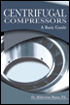
Providing an up-to-date reference in the field of centrifugal compressors, this comprehensive book covers all major aspects of design, operation, and maintenance.
 TABLE OF CONTENTS
 A compressor is a device that pressurizes a working fluid. One of the basic aims of using a compressor is to compress the fluid and deliver it at a pressure higher than its original pressure. Compression is required for a variety of purposes, some of which are listed below:
To provide air for combustion
To transport process fluid through pipelines
To provide compressed air for driving pneumatic tools
To circulate process fluid through a certain process
Different types of compressors are shown in Figure 1-1. The positive-displacement compressors are used for intermittent flow in which successive volumes of fluid are confined in a closed space to increase their pressures. The other broad class of compressors is the rotary type for continuous flow. In this type of compressor, rapidly rotating parts (impellers) accelerate fluid to a high speed; this velocity is then converted into additional pressure by gradual deceleration in the diffuser or volute, which surrounds the impeller. The positive-displacement type of compressors can be further classified as either reciprocating or rotary type, as shown in Figure 1-1. The reciprocating compressor has a piston having a reciprocating motion within a cylinder. The rotary positive-displacement compressors have rotating elements whose positive action results in compression and displacement. The rotary positive-displacement can be further subdivided into sliding vane, liquid piston, straight-lobe and helical-lobe type compressors.
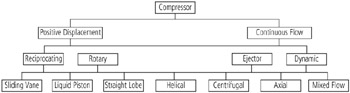
The continuous-flow type compressors, as shown in Figure 1-1, can be classified under dynamic or ejector type, entrain the inflowing fluid...