Centrifugal Compressors: A Basic Guide

Providing an up-to-date reference in the field of centrifugal compressors, this comprehensive book covers all major aspects of design, operation, and maintenance.
 TABLE OF CONTENTS
 The simplest model of a rotating machine consists of a large disc mounted on a flexible shaft with the ends mounted in rigid supports. The rigid supports constrain a rotating machine from any lateral movement but allow free angular movement. A flexible shaft operates above its first critical. Figures 11-2 and 11-3 show such a shaft. The mass center of the disc "e" is displaced from the shaft centerline or geometric center of the disc due to manufacturing and material imperfections. When this disc is rotated at a rotational velocity ?, the mass causes it to be displaced so that the center of the disc describes an orbit of radius ? r from the center of the bearing centerline. If the shaft flexibility is represented by the radial stiffness ( K r), it will create a restoring force on the disc of K r ? r that will balance the centrifugal force equal to ? 2 ( ? r + e). Equating the two forces obtains
| (11-5) | 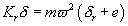 |
Therefore,
| (11-6) | 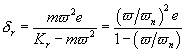 |
where omega ? n= K r/m, the natural frequency of the lateral vibration of the shaft and disc at zero speed.
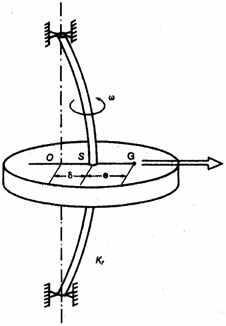
The previous equation shows that when ? < ? n, ? r is positive. Thus, when operating below the critical speed, the system rotates with the center of mass on the outside of the geometric center.