Centrifugal Compressors: A Basic Guide

Providing an up-to-date reference in the field of centrifugal compressors, this comprehensive book covers all major aspects of design, operation, and maintenance.
 TABLE OF CONTENTS
 Steam turbines are some of the most common drives for centrifugal compressors. In chemical plants, steam turbines are widely used, due to the fact that most of these plants need steam or generate it in their processes. Figure 9-1 is a centrifugal compressor driven by a steam turbine. Thus, by using steam turbines, the plant can utilize most of the excess steam thus using energy more efficiently. In the combined cycle utilities plants, combinations of gas turbines and steam turbines are being utilized to obtain high overall efficiencies. In this configuration, the hot gasses from the gas turbine are used to generate the steam for the steam turbine.
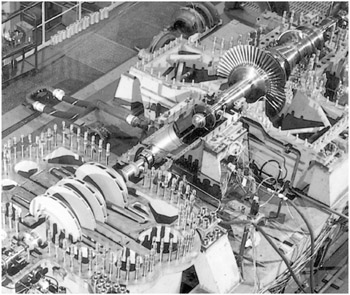
A steam turbine may be defined as a form of heat engine in which the energy of the steam is transformed into kinetic energy by means of expansion through nozzles, and the kinetic energy of the resulting jet is, in turn, converted into force doing work on rings of blading mounted on a rotating part. The basic idea of steam turbines was conceived as early as 120 BC, yet it was not until 1883 that the first practical steam turbine was developed by De Laval.
A typical steam turbine power plant is divided into its heat sources, the boiler or steam generator, and the turbine cycle, which includes the turbine, generator, condenser pumps, and feedwater heaters. The steam turbine operates on the Rankine Cycle.