Centrifugal Compressors: A Basic Guide

Providing an up-to-date reference in the field of centrifugal compressors, this comprehensive book covers all major aspects of design, operation, and maintenance.
 TABLE OF CONTENTS
 All rotating machinery is assumed to have an unbalance. Unbalance produces excitation at the rotational speed. The natural frequency of the system ? n is also known as the critical shaft speed. From the study of the forced-damped system, the following conclusions can be drawn:
the amplitude ratio reaches its maximum values at
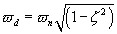
the damped natural frequency ? n does not enter the analysis of the forced-damped system.
The more important parameter is ? n, the natural frequency of the undamped system.
In the absence of damping, the amplitude ratio becomes infinite at ? = ? n. For this reason, the critical speed of a rotating machine should be kept away from its operating speed.
Small machinery involves small values of mass m and has large values of the spring constant k (bearing stiffness). This design permits a class of machines, which are small in size and of low speed in operation, to operate in a range below their critical speeds. This range is known as subcritical operation, and it is highly desirable if it can be attained economically.
The design of large rotating machinery centrifugal compressors, gas and steam turbines, and large electrical generators pose a different problem. The mass of the rotor is usually large, and there is a practical upper limit to the shaft size that can be used. Also, these machines operate at high speeds.
This situation is resolved by designing a system with a very low critical...