Centrifugal Compressors: A Basic Guide
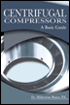
Providing an up-to-date reference in the field of centrifugal compressors, this comprehensive book covers all major aspects of design, operation, and maintenance.
 TABLE OF CONTENTS
 Diffusers are designed to convert the high velocity exiting from the impeller to static pressure. The velocity in a diffuser is reduced, and the static pressure is increased while the total pressure and temperature remains constant. In a subsonic diffuser, the flow area increases. The diffuser throat is a region where the Mach number reaches sonic flow and controls the flow in the diffuser. Choke conditions are reached when the Mach number reaches 1.0 and thus no more flow can be sent through the diffuser.
Diffusing passages have always played a vital role in obtaining good performance from turbomachines. Their role is to recover the maximum possible kinetic energy leaving the impeller with a minimum loss in total pressure. The velocity of the fluid is converted to pressure, partially in the impeller and partially in the stationary diffusers. Most of the velocity leaving the impeller is converted into pressure energy in the diffuser. It is normal practice to design the compressor so that half the pressure rise takes place in the impeller and the other half in the diffuser. The efficiency of centrifugal compressor components has been steadily improved by advancing their performance. However, significant further improvement in efficiency will be gained only by improving the pressure recovery characteristics of the diffusing elements of these machines, since these elements have the lowest efficiency.
The performance characteristics of a diffuser are complicated functions of diffuser geometry, inlet flow conditions, and exit flow conditions. Figure 5-1 shows typical vaneless diffusers classified...