Centrifugal Compressors: A Basic Guide

Providing an up-to-date reference in the field of centrifugal compressors, this comprehensive book covers all major aspects of design, operation, and maintenance.
 TABLE OF CONTENTS
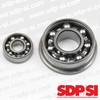
 The bearings in turbomachines provide support and positioning for the rotating components. Radial support is generally provided by journal or roller bearings, and axial positioning is provided by thrust bearings. Some engines, mainly aircraft jet engines, use ball or roller bearings for radial support, but nearly all-industrial turbomachinery use journal bearings.
A long service life, a high degree of reliability, and economic efficiency are the chief aims when designing bearing arrangements. To reach these criteria, design engineers examine all the influencing factors:
Load and speed
Lubrication
Temperatures
Shaft arrangements
Life
Mounting and dismounting
Noise
Environmental Conditions
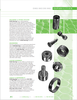
The heavy frame type gas turbines use journal bearings. Journal bearings may be either full round or split; the lining may be heavy, as in large-size bearings for heavy machinery, or thin, as used in precision insert-type bearings in internal combustion engines. Most sleeve bearings are of the split type for convenience in servicing and replacement. Often in split bearings, where the load is entirely downward, the top half of the bearing acts only as a cover to protect the bearing and to hold the oil fittings. Figure 11-20 shows a number of different types of journal bearings. A description of a few of the pertinent types of journal bearings follows:
Plain Journal. Bearing is bored with equal amounts of clearance (on the order of one and one-half to two thousands of an inch per inch of journal diameter) between the journal and bearing.
Circumferential grooved bearing. Normally has...