Centrifugal Compressors: A Basic Guide
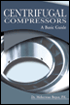
Providing an up-to-date reference in the field of centrifugal compressors, this comprehensive book covers all major aspects of design, operation, and maintenance.
 TABLE OF CONTENTS
 There are many types of forces that act on a rotor-bearing system. The forces can be classified into three categories: (1) casing and foundation forces, (2) forces generated by rotor motion, and (3) forces applied to a rotor. Table 11-1 by is a compilation of these forces.
| Source of Force | Description | Application |
|---|---|---|
| Constant, unidirectional force Constant force, rotational Variable, unidirectional Impulsive forces Random forces | Constant liner acceleration Rotation in gravitational or magnetic field Impressed cyclic ground or foundation-motion Airblast, explosion, or earthquake Nearby unbalanced machinery Blows, impact |
| Rotating unbalance; residual, or bent shaft Coriolis forces Elastic hysteresis of rotor Coulomb friction Fluid friction Hydrodynamic forces, static. Hydrodynamic forces, dynamic. Dissimilar elastic beam Stiffness reaction forces Gyroscopic moments | Present in all rotating machinery Motion around curve of varying radius. Space applications Rotary-coordinated analyses Property of rotor material which appears when rotor is cyclically deformed in bending, torsionally or axially Construction damping arising from relative motion between shrink-fitted assemblies Dry-friction bearing whirl Viscous shear of bearings Fluid entrainment in turbomachinery Windage Bearing load capacity Voute pressure forces Bearing stiffness and damping properties Rotors with differing rotor lateral stiffness. Slotted rotors, electrical machinery, Keyway. Abrupt speed change conditions Significant in high-speed flexible rotors with discs |
| Drive torque Cyclic forces Oscillating torques Transient torques Heavy applied rotor force Gravity Magnetic field: stationary or... |