Microwave Radiometer Systems: Design and Analysis, Second Edition
In remote sensing, situations arise that require radiometric measurements with large antennas that must be scanned (moved) in order to form images. An example occurs in remote sensing of soil moisture where science requirements for spatial resolution lead to antenna systems so large that they may not be practical. Requirements already exist for antennas in excess of 10m in diameter for remote sensing from space [1].
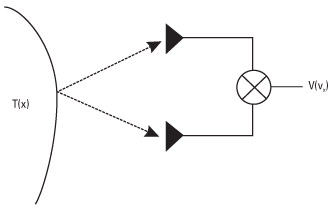
Aperture synthesis is a technique for overcoming the limitation that a large antenna aperture places on passive microwave remote sensing from space. This is an interferometric technique in which pairs of small antennas are used together with signal processing to achieve the resolution of a single large aperture antenna. In this technique, the product of the signal from each pair of antennas is measured using a correlation radiometer (see Figure 8.1 and also the basic correlation radiometer in Chapter 7). The complex product (real and imaginary part) is recorded for pairs of antennas at many different spacings. The spacing is called a baseline and both the magnitude and orientation of the distance between the antennas is important.
It can be shown that the output signal at each baseline produces a sample point of the Fourier transform of the scene at a "frequency" that depends on the distance between the antennas. Realizing this, the idea...