Microwave Radiometer Systems: Design and Analysis, Second Edition
Chapter 3: The Radiometer Receiver: Sensitivity and Accuracy

3.1 What Is a Radiometer Receiver?

The objective of a radiometer is to measure power. However, in many microwave applications, such as remote sensing of the Earth's surface, it is common practice to express power in terms of an equivalent temperature. This may be the temperature of a blackbody that would radiate the same power, called the brightness temperature, T B, or the temperature of a resistor (termination) that has the same output power as that of the receiving antenna, called the antenna temperature, T A. At microwave frequencies the Rayleigh-Jeans law is applied to express power in terms of temperature.

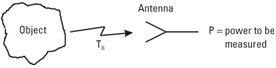
Now, consider an idealized antenna pointed towards an object of interest with equivalent brightness temperature, T B (see Figure 3.1).


Figure 3.1: The measurement situation.

The output power of the antenna is expressed in terms of its antenna temperature, T A. The goal of the measurement is usually to relate the antenna temperature to the brightness temperature of the object. The task of the microwave radiometer is to measure this antenna temperature with sufficient resolution and accuracy that this connection can be made. In this sense, the radiometer is simply a calibrated microwave receiver.

3.2 The Sensitivity of the Radiometer

The next step in the description of the microwave radiometer is illustrated in Figure 3.2.


Figure 3.2: Idealized radiometer.

The radiometer selects a certain portion of the available output power from the antenna, that is, a certain bandwidth B around a given...

UNLIMITED FREE
ACCESS
TO THE WORLD'S BEST IDEAS

SUBMIT
Already a GlobalSpec user? Log in.

This is embarrasing...

An error occurred while processing the form. Please try again in a few minutes.

Customize Your GlobalSpec Experience

Category: Radiometers
Finish!
Privacy Policy

This is embarrasing...

An error occurred while processing the form. Please try again in a few minutes.